See how your chess really compares.
Grand Report analyzes your games across six areas of your chess and shows how you compare with players at your level.
Explore your scores, peer averages, and percentiles to understand where you excel, where you fall behind, and what you should work on next.
Free report based on your 20 most recent games. No manual uploads needed.
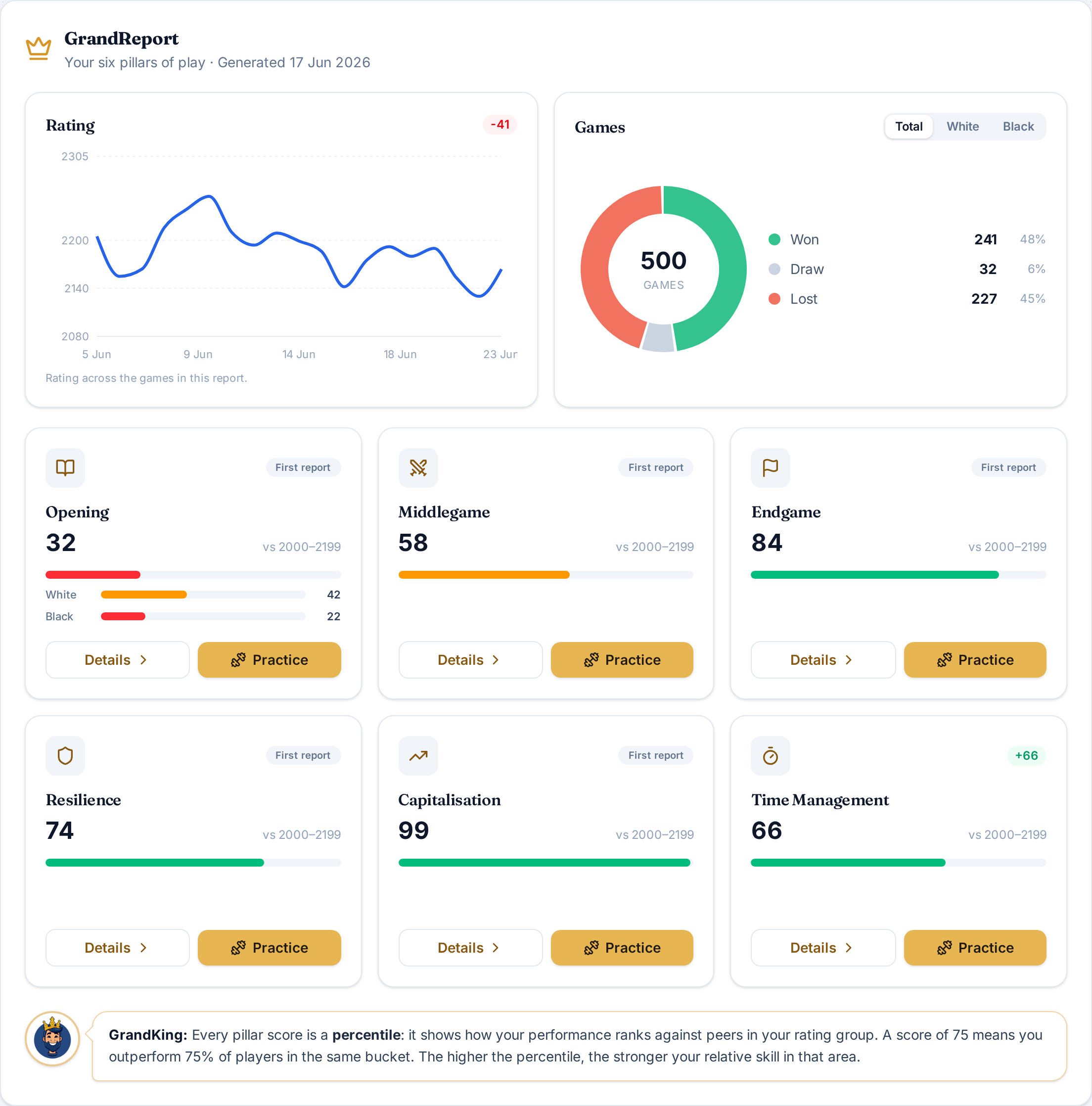
What is Grand Report?
A complete picture of how you play.
Grand Report analyzes a collection of your own games and turns them into a detailed picture of your chess performance.
Instead of looking at one game in isolation, Grand Report evaluates your play across six areas: Opening, Middlegame, Endgame, Capitalisation, Resilience, and Time Management.
For each area, you can see how you perform and how your results compare with other players at your level. Percentiles and peer benchmarks put your performance into context, so you can see where you stand rather than looking at a score on its own.
And Grand Report goes deeper than the six headline scores. Explore the details behind each pillar — from the openings you perform best and worst in, to your average inaccuracies, mistakes and blunders, to the endgame positions where you gain or lose the most.
The result is not simply an analysis of your games. It is a detailed view of how you play, how you compare, and where you can improve.
The six pillars of your chess
See how you perform across every part of your game.
Opening
See how well you perform in the opening phase of your games. Explore your results across different openings and identify the openings where your performance is strongest and weakest.
Middlegame
Understand the quality of your middlegame play. See your inaccuracies, mistakes and blunders, how often they occur, and how your results compare with players at your level.
Endgame
See how you perform when games reach the endgame. Explore which types of endgames you handle well and where your performance falls behind your peers.
Capitalisation
Measure how well you turn good and winning positions into results. See how often you convert your advantages and how your conversion compares with other players at your level.
Resilience
See how well you respond when your position starts to deteriorate. Measure your ability to recover from difficult positions and compare your results with players at your level.
Time Management
Understand how effectively you use your clock. See where time pressure affects your play and how your time management compares with players at your level.
How to read your Grand Report
Your score is the starting point.
Grand Report gives you a score for each pillar, but the real insight comes from understanding what that score means. Use your peer average, percentile, and the details behind each pillar to put your performance into context.
Look at your percentile
Your percentile shows how your performance compares with other players at your level. A higher percentile means your performance is stronger relative to your peers; a lower percentile highlights an area where there is more room to improve.
Don't judge a pillar in isolation
A score only tells part of the story. Look at the peer comparison and then explore the details behind the pillar. A middlegame score, for example, can be understood through your inaccuracies, mistakes and blunders and how these compare with your peers.
Explore the details
Your pillar scores are an overview, not the end of the analysis. Dive deeper to see which openings you perform best in, where your tactical errors occur, which endgames you handle well, and where you lose ground compared with other players.
Focus on where the gap is largest
Your lowest percentile can be a useful place to start, but it is not automatically your biggest weakness. Look at the size of the gap with your peers and the underlying data to decide where training can make the biggest difference.
Track your progress
Your Grand Report can be used as a benchmark for your own improvement. Compare reports over time to see how your scores and percentiles change as you train.
From games to insight
How GrandChess turns your games into a complete picture of your chess.
GrandChess starts with your own games and turns them into measurable insights about how you play. Your games are analyzed, your performance is evaluated across six pillars, and your results are compared with players at your level.
From there, Grand Report lets you explore the details behind your performance and identify where your biggest opportunities for improvement lie.
Your games
Imported automatically from your Chess.com or Lichess account.
Analysis
Engine-based analysis identifies the key moments and performance data in your games.
Performance
Your games are evaluated across six pillars of chess, from opening play to time management.
Comparison
Your results are compared with players at your level using peer averages and percentiles.
Grand Report
Explore your overall performance and dive deeper into the details behind each pillar.
Training
Turn your insights into targeted training in your Grand Training Room.
Why analyze multiple games?
One game shows what happened. Multiple games show how you play.
One game
A single game can tell you what happened in that game: where you made mistakes, which moves mattered, and how the game was decided.
But one game is only a snapshot.
Multiple games
When GrandChess analyzes many games, it can measure your performance across a much broader sample and put your results into context.
You can see how you perform across different parts of your game, which openings and endgames suit you best, how often you make inaccuracies, mistakes and blunders, and how your performance compares with players at your level. That makes Grand Report more than an analysis of individual games. It gives you a broader picture of your chess.
Two ways to analyze
Grand Report vs. individual game analysis
Individual game analysis
Available in GrandChess through Recent Games.
- What happened in this game?
- Where did it go wrong?
- Which moves were important?
- What can I learn from this particular game?
Grand Report
Built from a collection of your own games within one time control.
- How do I perform across the six pillars of chess?
- How do I compare with players at my level?
- What are my strongest and weakest areas?
- Which openings and endgames do I perform best in?
- How do my inaccuracies, mistakes and blunders compare with my peers?
- Where should I focus my training?
From insight to improvement
Turn your report into training.
Grand Report helps you understand where your chess stands and where you have the most room to improve. The Grand Training Room turns those insights into something you can actually work on.
Train tactics, openings, endgames, capitalisation, resilience and time management, with training opportunities based on your own games alongside targeted chess exercises.
Train your weaknesses- Tactics training from your own games
- Opening trainer and repertoire review
- Endgame training
- Checkmate patterns
- Time management training
- Resilience training
- Woodpecker cycles
- Exams to measure progress
How many games do I need?
A broader sample gives you a better picture of your chess.
Grand Report is designed to evaluate your chess across a collection of games rather than a single performance. With more games, your scores and comparisons are based on a broader sample of your play, making it easier to see which areas consistently stand out.
The free Grand Report analyzes your 20 most recent games in a time control of your choice. With Premium, you can build reports from up to 500 games and track how your performance and pillar scores develop between reports over time.
FAQ
Questions, answered.
What is Grand Report?
Grand Report is a personal chess performance report by GrandChess. Instead of analyzing just one game, it evaluates a collection of your own games across six areas of chess. You can see how you perform, how your results compare with players at your level, and where you have the most room to improve.
How does Grand Report analyze my chess?
GrandChess imports your games and uses engine-based analysis to evaluate key moments in each game. The results are then used to measure your performance across six pillars and compare it with other players at your level. You can also explore the details behind each pillar, including your openings, tactical errors and endgame performance.
How many games does Grand Report analyze?
The free Grand Report is based on your 20 most recent games in a time control of your choice. With Premium, you can build reports from up to 500 games, giving you a broader sample of your play and a more complete picture of your performance.
What are the six pillars of Grand Report?
Opening measures how you perform in the opening phase of your games. Middlegame looks at the quality of your play and your inaccuracies, mistakes and blunders. Endgame measures your performance in endgame positions. Capitalisation looks at how well you convert better positions into results. Resilience measures how well you respond when your position turns against you. Time Management looks at how effectively you use your clock.
Is Grand Report different from chess engine analysis?
Yes. Engine analysis tells you what happened in an individual game and helps explain why particular moves were good or bad. Grand Report uses that analysis to evaluate your performance across many games. It puts your results into context by comparing them with players at your level and lets you explore the details behind each area of your chess.
Can Grand Report identify my chess weaknesses?
Grand Report can highlight areas where your performance is weaker relative to your peers. For example, you may discover that your middlegame performance is below average, that you make more blunders than players at your level, or that certain openings or endgames are areas where you perform particularly well or poorly. These insights can help you decide what to train.
Can I use Grand Report with Chess.com games?
Yes. You can use your Chess.com or Lichess username to import your recent games. No manual uploads are needed.
How does Grand Report help me improve at chess?
Grand Report gives you a clearer picture of where your chess stands and where you have the most room to improve. You can use your pillar scores, percentiles and detailed results to choose what to work on. Those insights connect with the Grand Training Room, where you can train tactics, openings, endgames, capitalisation, resilience and time management.
Know your chess. Train what matters.
Your free Grand Report analyzes your 20 most recent games and shows where you stand across six pillars of chess, how you compare with your peers, and where you can improve next.